
-
Seminário com Dr. Adamu Issifu – 28 de abril de 2023 (sexta-feira) – 10h15min
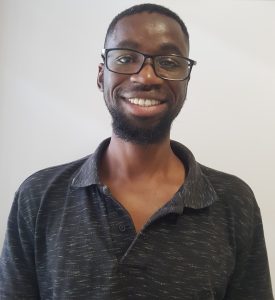
O PROGRAMA DE PÓS-GRADUAÇÃO EM FÍSICA convida para o seminário:
Unification of QCD Running Coupling and β-funtion on any Q²scale*
Dr. Adamu Issifu
Pós-doutorando do PPGFSC
*Evento de presença obrigatória da disciplina seminários
Resumo:
In this work, we investigate QCD-like running coupling αsAdS(Q²) and its associated β-function β(Q²) in the spirit of tachyonic AdS/QCD. We distort the AdS5 conformal symmetry using a color dielectric function G(ϕ(z)) associated with tachyons, with ϕ(z) the tachyon field. The G(ϕ(z)) presents different properties of αsAdS(Q²) at small and large values of the fifth-dimensional holographic variable z. The G(ϕ(z)) distorts the AdS5 space, giving αsAdS(Q²) and its β(Q²) at any Q²scale. The result obtained for large value of z shows characteristics similar to nonperturbative QCD. On the other hand, the result obtained for a small value of z shows characteristics similar to perturbative QCD. Free tachyons are responsible for distortions at small z. On the contrary, condensed tachyon states lead to large z distortion. This provides a unified background for determining αsAdS(Q²) and its β(Q²) in both the ultraviolet (UV) and infrared (IR) regions in a unified framework.
Furthermore, we show that the tachyonic field ϕ is associated with glueball field φ, and the color dielectric function is associated with higher dimensional operator HµνHµν coupled to a Standard Model (SM) gauge field OSM that leads to strongly interacting light glueballs. The results obtained from the study are compared with effective couplings determined from different observables such as; lattice QCD, QCD phenomenology, and g1 scheme extracted from the well-measured Bjorken sum rule. Our approach brings new perspective to AdS/QCD, where pQCD coupling characteristics can be determined through direct UV deformation of the AdS5 space instead of extrapolation from the IR deformation of the AdS space. Again, we determine the parameter that controls the transition from the pQCD to nonperturbative QCD.
Finally, we show that αs(Q²) and β(Q²) are related to strongly interacting scalar glueballs with mass mϕ and discuss its effect. Landau singularity that marks the failure of perturbative QCD was examined in the model framework. The αs(Q²) is a subject of active research due to its limited understanding in the low momentum transfer region. A good knowledge of αs(Q²) at Q → ∞ is also necessary to match the growing precision of hadron scattering experiments and enhance the understanding of high energy unification of strongly interacting and electroweak theories. Nonetheless, a precise understanding of αs(Q²) at Q → 0 on the scale of proton mass enables us to understand hadron structure, confinement, and hadronization.
[1] A. Deur, S. J. Brodsky and G. F. de Teramond, The QCD Running Coupling, Prog. Part. Nuc. Phys. 90, 1 (2016) [1604.08082].
Data: 28 de abril de 2023 (sexta-feira) – Horário: 10h15min
Local: Sala 212 – Auditório do Departamento de Física
-
Seminário com Profa. Dra. Nara Rubiano da Silva – 14 de abril de 2023 (sexta-feira) – 10h15min

O PROGRAMA DE PÓS-GRADUAÇÃO EM FÍSICA convida para o seminário:
Solucionando opticamente um problema matemático*
Profa. Dra. Nara Rubiano da Silva
UFSC Blumenau
*Evento de presença obrigatória da disciplina seminários
Resumo:
Tarefas computacionais complexas são cada vez mais necessárias para lidar com a grande quantidade de dados que produzimos em nosso dia-a-dia. Podemos atacar esta complexidade seja desenvolvendo novos algoritmos (como redes neurais) ou novas plataformas computacionais (como computadores quânticos). Neste seminário, apresentarei uma proposta que se encaixa na segunda categoria: um processador óptico para a realização de uma operação matemática específica, mas básica para uma ampla gama de algoritmos, a multiplicação de um vetor por uma matriz. Para isso, os elementos de matriz são mapeados no perfil de fase de um feixe laser, e elementos ópticos são utilizados para realizar as operações matemáticas necessárias. Introduzirei também um problema de otimização relevante que pode ser abordado com nosso processador, o problema de geometria de distâncias.
Data: 14 de abril de 2023 – (sexta-feira) – Horário: 10h15min
Local: Sala 212 – Auditório do Departamento de Física
-
(Português) Homologação das inscrições do processo seletivo PDSE 2023
Neste link está o resultado da homologação de inscrições de estágio no exterior pelo Programa de Doutorado Sanduíche no Exterior (PDSE/CAPES) para o ano de 2023.



(Português) Alunos Estrangeiros – Informações
(Português) 
(Português) Acesso CAPG
(Português) 
Contatos


Facebook Auto Publish Powered By : XYZScripts.com