A Comissão de Processo Seletivo informa que após análise e resposta do recurso apresentado ao resultado final do processo seletivo para ingresso nos cursos de mestrado e doutorado do semestre 2016/2, decidiu por manter o resultado final publicado no dia 21 de junho de 2016.
O PROGRAMA DE PÓS-GRADUAÇÃO EM FÍSICA convida para o seminário:
Oscilações Quânticas de Neutrinos e o Prêmio Nobel de Física de 2015*
Prof. Dr. Marcelo M. Guzzo
Instituto de Física da UNICAMP
*Evento de presença obrigatória para os alunos matriculados na disciplina seminários
Resumo:
O Prêmio Nobel de Física de 2015 foi concedido aos Profs. McDonald e Kajita, coordenadores dos experimentos SNO e Superkamiokande, pelas “descobertas das oscilações quânticas de neutrinos, que mostraram que os neutrinos têm massa”. Neste seminário apresentaremos as características e a história desta partícula misteriosa e onipresente cujos estudos receberam, até o momento, oito Prêmios Nobel de Física. Enfatizaremos as oscilações quânticas de neutrinos e a necessidade de massa para os neutrinos.
Data: 24 de junho de 2016 – (sexta-feira) – Local: Sala 212 – Auditório do Departamento de Física – Horário: 10h15min
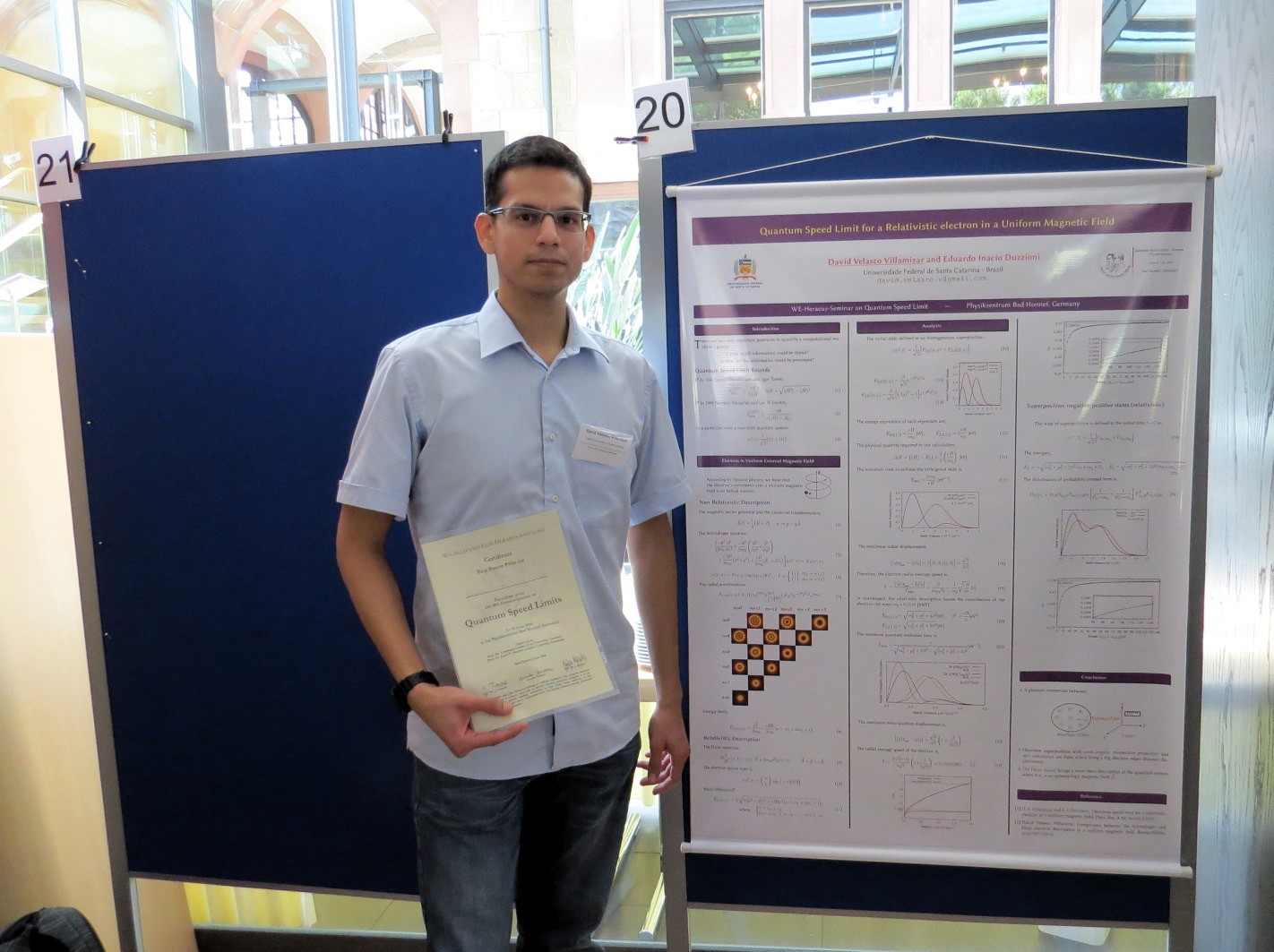
O discente do curso de doutorado David Velasco Villamizar foi um dos ganhadores do prêmio melhor poster do evento científico 619. WE-Heraeus-Seminar, realizado no período de 8 a 10 de junho de 2016 no Physikzentrum Bad Honnef, Alemanha.
David foi o único representante da América do Sul inscrito no evento. O título de seu trabalho é: Quantum Speed Limits
O PPGFSC/UFSC parabeniza o discente e seu orientador pelo reconhecimento da excelência no desenvolvimento da pesquisa.
Segue abaixo o vídeo da entrega da premiação e apresentação do trabalho.
O Programa de Pós-Graduação em Física da Universidade Federal de Santa Catarina – UFSC torna pública a relação das inscrições homologadas no Processo Seletivo para ingresso no semestre 2016/2.
Click aqui e tenha acesso à lista de candidatos inscritos e sua respectiva situação no processo seletivo.
Os recursos quanto as inscrições devem ser encaminhados do dia 13 de junho de 2016 a 15 de junho de 2016 até as 17 horas.
O PROGRAMA DE PÓS-GRADUAÇÃO EM FÍSICA convida para o seminário:
On The Spin Evolution of Isolated Pulsars*
Dr. Oliver Q. Hamil
Pós-doutorando – UFSC/FSC
*Evento de presença obrigatória para os alunos matriculados na disciplina seminários
Resumo:
Isolated pulsars are a class of neutron stars that are spinning at high frequencies, and emit beams of electromagnetic radiation into space which appear like lighthouses to observers on earth. Observations of these objects span a few decades, and some of them have been documented with very high accuracy. Measurements of the pulsar rotational velocity Ω, and its time derivatives Ω and ̇ Ω, show that they slow down over time. The generally ̈ accepted explanation for the spin-down is that the pulsars behave like magnetic dipoles that lose energy in the form of electromagnetic radiation causing them to slow over time. This assumption of magnetic dipole radiation (MDR) leads to a general power law constructed from observation, Ω = ̇ −KΩ n is exactly 3 for MDR, but accurate observational measurements consistently yield values of 1.0 < n < 2.8. The reason for this discrepancy is unknown. In the present work we aim to improve understanding of the braking index through a two pronged investigation. We approach the problem by allowing for dynamical changes in the neutron star properties required in the braking index solution. We develop a frequency dependent model of the braking index that allows changing moment of inertia of the star, and changes in magnetic field properties in the MDR torque mechanism. For the first time, we have the opportunity to use physically realistic equations of state, along with state of the art computational codes to determine the dynamic properties of the neutron star needed in the modified braking index model. We probe the stars at constant baryonic rest masses ranging from 1.0M to 2.2M over a range of frequency spanning from zero to the Kepler (mass shedding) frequency for each star. We find that the braking index is sucseptible to changes in moment of inertia at very high frequencies, but unaffected in the lower frequency range where all of the reliably measured pulsars rotate. At low frequencies, however, we were able to again match the measured values by allowing for a change in the orientation of the magnetic moment of the dipole over time, in light of recent developments in the literature.
Data: 10 de junho de 2016 – (sexta-feira)- Local: Sala 212 – Auditório do Departamento de Física – Horário: 10h15min
Rua Roberto Sampaio Gonzaga, s/n
Campus Universitário - Centro de Ciências Físicas e Matemáticas/CFM - Departamento de Física - sala 203
Trindade - Florianópolis - SC - Brasil
Cx. Postal 5064 - CEP 88035-972