
-
Exame Unificado de Pós-Graduações em Física 2026-1 (EUF)
Estará aberto, no período de 16 de fevereiro a 24 de março de 2026, o prazo para inscrições no Exame Unificado de Física (EUF) 2026-1. As inscrições deverão ser realizadas pela internet, por meio do site oficial do exame:
👉 https://euf.ifi.unicamp.br/EUF/listarevento.aspx?12026EUF
A prova será aplicada no dia 15 de abril de 2026 e poderá ser realizada no Departamento de Física da Universidade Federal de Santa Catarina (UFSC), em Florianópolis, bem como em diversas outras localidades no Brasil e no exterior.
O Programa de Pós-Graduação em Física da UFSC (Florianópolis) utiliza, entre outros critérios de seleção, as notas do Exame Unificado das Pós-Graduações em Física (EUF) para o ingresso nos cursos de mestrado e doutorado. A nota obtida no exame constitui parte importante do processo de classificação dos candidatos.

-
(Português) XII Encontro de Física e Astronomia da UFSC
Entre os dias 24 e 27 de fevereiro de 2026, acontecerá em Florianópolis, no campus central da UFSC (auditório do EFI), o XII Encontro de Física e Astronomia. O evento terá inscrição gratuita e reunirá pesquisadores, estudantes e interessados para uma semana de intensa troca científica.
A programação do evento inclui palestras com especialistas, minicursos técnicos em diversas áreas da física e da astronomia, além de sessões de pôsteres e seminários. Participantes interessados em apresentar trabalhos podem submeter seus resumos até 11 de fevereiro de 2026.
Mais informações, inscrições e programação completa estão disponíveis no site oficial do evento:
👉 https://encontro-pgfsc.ufsc.br/2026 -
(Português) Aviso de Recesso – Secretaria do PPGFSC
Informamos que, em razão do recesso para as comemorações de fim de ano (Natal e Ano Novo), não haverá expediente na secretaria do PPGFSC nos seguintes períodos:
- 22/12 a 29/12
- 31/12 e 01/01/2026
As atividades do dia 02/01 acontecerão em regime de teletrabalho.
O atendimento presencial retornará no dia 05/12 das 07h às 13h.
Agradecemos a compreensão e desejamos a todos boas festas! 🎄✨
-
(Português) Horário de verão 2025/2026
☀️Horário de Verão na UFSC ☀️
De 15 de dezembro de 2025 a 06 de março de 2026, a UFSC funciona em horário de verão. Nesse período, o expediente de servidores docentes e técnico-administrativos ocorre no turno matutino, das 7h às 13h, conforme determinado pela Portaria Normativa 525/2025/GR.
-
(Português) Resultado final 2ª Chamada do PDSE 2025-2 (início no 2º semestre de 2026)
Divulgamos o resultado final da 2ª Chamada do Programa de Doutorado Sanduíche no Exterior (PDSE/CAPES) para o ano de 2026 (início 2º semestre).
-
(Português) Resultado preliminar 2ª Chamada do PDSE 2025-2 (início no 2º semestre de 2026)
Divulgamos o resultado preliminar da 2ª Chamada do Programa de Doutorado Sanduíche no Exterior (PDSE/CAPES) para o ano de 2026 (início 2º semestre).
Prazo para apresentação de recursos do resultado preliminar: 03 até 05 de dezembro de 2025 (o link do formulário de recurso está no edital).
-
Master’s, PhD and Post-Doc Scholarship Opportunity
PPGFSC is offering master’s, PhD and Post-doc scholarships linked to specific projects by Prof. Nara Rubiano da Silva (Quantum Optics) and Prof. Maurício Girardi-Schappo (Statistical Mechanics).
This opportunity is mainly for those who took the last selection exam and are currently without a scholarship. However, students who are just starting the program and have not yet been awarded a scholarship nor defined an advisor can also take advantage of the opportunity (in this case, the duration of the scholarship cannot exceed the course completion deadline plus the maximum extension).
For more information, contact one of the two professors below directly.
Master’s Scholarship for Women – Quantum Optics Laboratory (Prof. Nara Rubiano da Silva)
The Quantum Optics Laboratory at UFSC conducts research in the field of optical information processing, an innovative approach that seeks to solve fundamental computing problems – such as matrix products – using optical systems instead of electronic ones. This research line opens perspectives for performing calculations more efficiently and for developing neural networks based on optical platforms.
We are offering a master’s scholarship for women, with possible work in three complementary areas:
- Experimental: direct participation in the optical table, assembling and characterizing experiments;
- Simulations: development of computational models to study and optimize the efficiency of optical systems;
- Control and automation: creation and implementation of computational strategies for equipment control and operation.
Interested candidates are invited to contact Prof. Nara Rubiano da Silva (📧
 ) for more information and to discuss possible research topics, combining experimental and theoretical aspects according to the candidate’s profile.
Doctoral and Postdoctoral Scholarships — NeuroPhysics Laboratory (Prof. Maurício Girardi-Schappo)
The NeuroPhysics Laboratory is part of the INCT of Neural Computing, a national and international collaboration network among Brazilian and foreign universities. Our goal is to understand and model the physical principles that govern information processing in the brain and in artificial neural networks.
We investigate topics such as stimulus sensitivity, memory formation, brain rhythms, and mechanisms associated with neurological diseases, such as epilepsy. We use techniques such as stochastic processes, out-of-equilibrium phase transitions, and nonlinear dynamics.
Fellows may work in at least two of the following areas:
- Theory and simulation of neural networks;
- Data-driven modeling: use of real clinical data from epilepsy patients;
- Mouse-robot: construction and programming of a robot to emulate spatial memory tasks;
- Experimental data analysis: in collaboration with groups from the University of Ottawa and PPGNeuro-UFSC.
There are two doctoral scholarships and ten postdoctoral scholarships available. Application period: December 1, 2025 to January 31, 2026 with Professor Maurício.
The selection will be conducted through an INCT selection process. The only prerequisite to apply for the doctoral scholarship is to have been accepted into the graduate program. To apply for the postdoctoral scholarships, the candidate must hold a doctoral degree and may apply for Junior (PDJ) or Senior (PDS) scholarships, depending on their profile
More information: Prof. Maurício Girardi-Schappo
🌐 neurophysicslab.com
📧
-
Final results of the PPGFSC 2026/1 selection process
The Postgraduate Program in Physics at the Federal University of Santa Catarina announces the final results of the selection process for admission to the PPGFSC 2026/1:
Click here to check.
-
Approval of registrations (post-appeals) and preliminary results of the 2026/1 Selection Process
The Graduate Program in Physics at the Federal University of Santa Catarina hereby announces the final list of approved applications and the preliminary results of the Selection Process for admission in the 2026/1 semester.
Click here and have access to the registered candidates’ list and their respective situations in the admission pro
-
PPGFSC Professor is Re-elected President of the Brazilian Materials Research Society
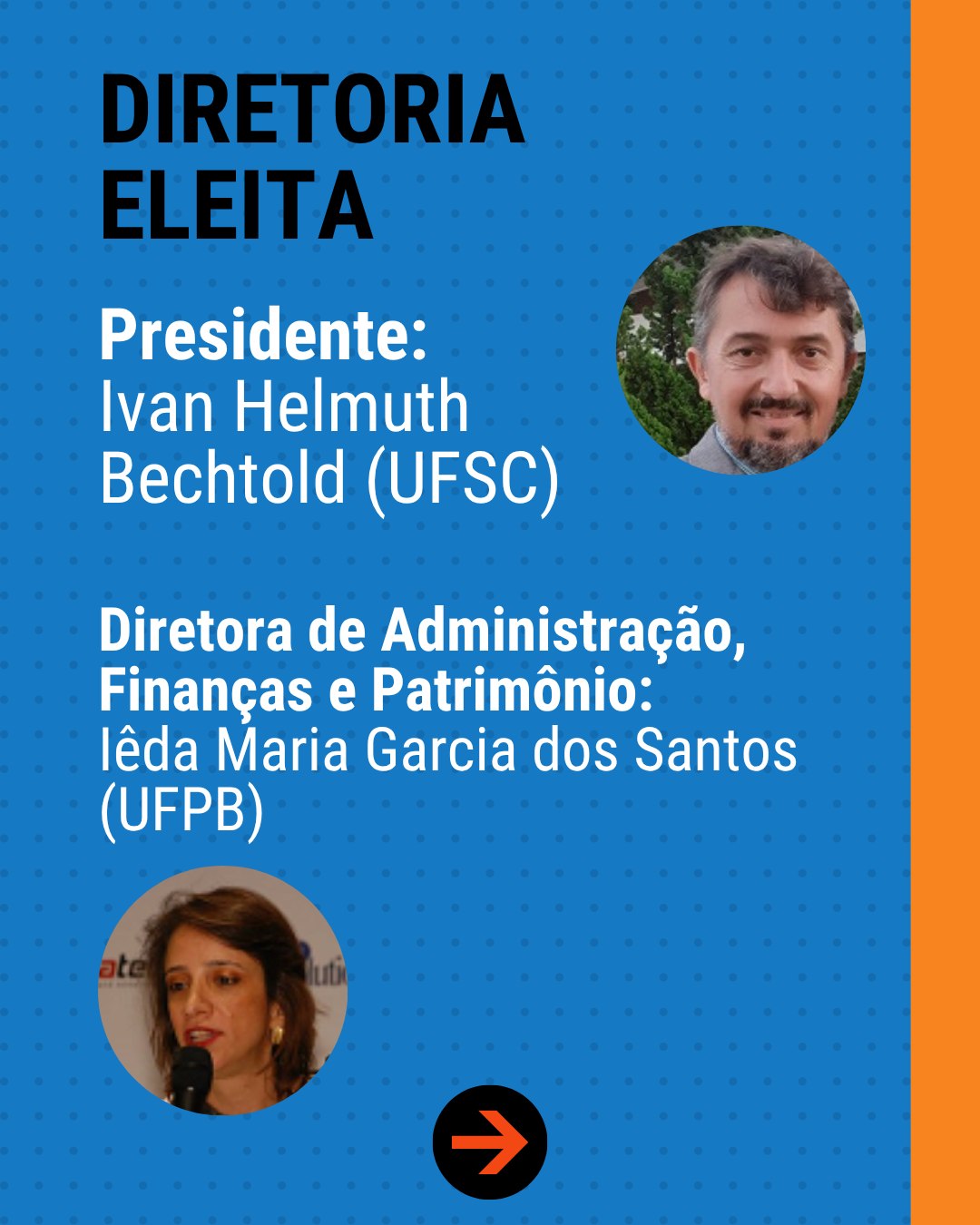
Elected directors of the SBPMat
Professor Ivan Bechtold, from the Department of Physics at the Federal University of Santa Catarina (UFSC), has been elected for a second two-year term (2026–2027) as President of the Brazilian Materials Research Society (SBPMat). SBPMat was founded in 2002, and Professor Ivan is the first researcher from outside the Southeast region to lead it.
The society brings together researchers from fields such as Physics, Chemistry, Mathematics, Biology, Health Sciences, Agricultural Sciences, and Engineering, all focused on the study and technological applications of materials. SBPMat’s annual event, internationally recognized in the field of materials, the Brazilian Materials Research Society (B-MRS), gathers around 2,000 participants from nearly every state in Brazil and also from abroad.
Ivan joined UFSC in 2006 and is currently a Full Professor in the Department of Physics. He is also a permanent faculty member of UFSC’s Graduate Programs in Physics (PPGFSC) and Chemistry (PPGQ).



Where we are
Contact


Facebook Auto Publish Powered By : XYZScripts.com